
Calhoun County Criminal Court Cases
Calhoun County criminal court records split between Circuit Court and District Court. Circuit Court in the Thirteenth Judicial Circuit handles felony and other general-jurisdiction criminal cases. The Arkansas Judiciary lists Circuit Clerk Jeanie Smith at P.O. Box 1175 in Hampton, with phone 870-798-2517 and fax 870-798-2428. The practical courthouse address for in-person court records is 309 West Main Street in Hampton.
District Court handles county and city cases, including lower-level criminal, traffic, fine, and ordinance matters. County cases use P.O. Box 864 and 870-798-2165. City cases use P.O. Box 783 and 870-798-2753. That split matters when a Calhoun County criminal case search involves a failure to appear, citation, or local charge that is not a felony circuit case.
The Arkansas Judiciary Calhoun directory is one manifest source for local court routing.
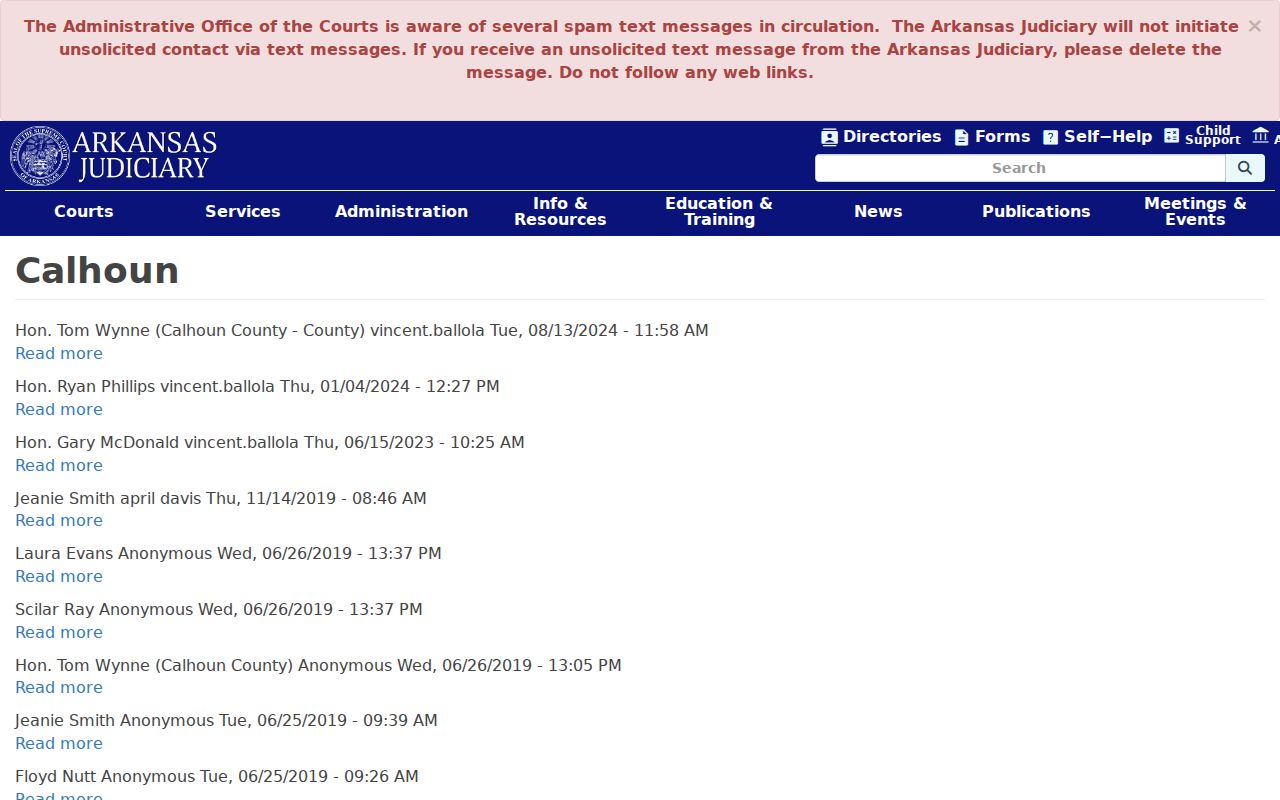
Use that directory as a routing source, then contact the specific court clerk for official case-file questions.
Calhoun Circuit Clerk Criminal Files
Felony and circuit criminal files route to the Calhoun County Circuit Clerk. The clerk is the custodian for official copies, certified dispositions, older files, and filed orders in circuit criminal cases. Search ARCourts may give enough case information to identify the file, but it does not replace the clerk when a person needs a certified judgment, sentence, or disposition.
Calhoun County Circuit Clerk
309 West Main Street, Hampton, AR 71744
P.O. Box 1175
870-798-2517
Fax 870-798-2428
Thirteenth Judicial Circuit
Calhoun County felony and circuit criminal files belong in this circuit court channel unless the case record says otherwise.
The manifest also includes the Arkansas Judiciary profile for the circuit clerk source.
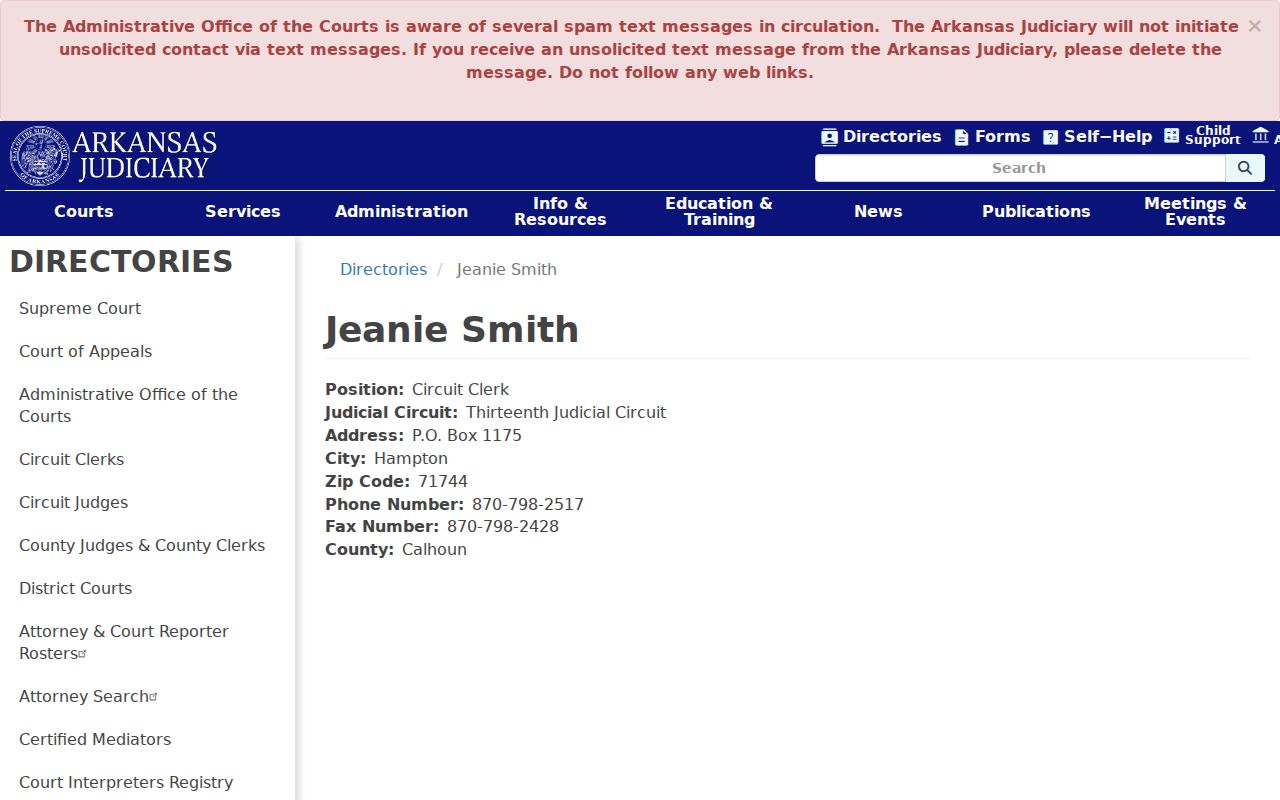
This is the office to ask about certified copies once the case number and court are known.
Searching Calhoun County Case Records
The main online path is Search ARCourts. The Arkansas Judiciary says the system supports public case information in courts using Contexte and can include parties, judge, filings, charges, dispositions, future events, judgments, and document links for some public records.
- Open Search ARCourts and start with participant search when using a person's name.
- Use first, middle, and last name when known, then try last name and filters if no record appears.
- Check whether the result is circuit court, district court county cases, or district court city cases.
- Read charges, dispositions, and future events before treating a case as final.
- Contact the listed clerk for copies, certified dispositions, or records not visible online.
| Field label | Type | Required | Notes |
|---|---|---|---|
| Search by | Dropdown | Unspecified | Participants is the main name-search context. |
| First Name | Text | Optional | Maximum length shown as 200 in captured markup. |
| Middle Name | Text | Optional | Use to separate similar names. |
| Last Name | Text | Expected | Try spelling variants if needed. |
| Organization or Case Description | Text | Optional | Used in another visible search context. |
| Advanced filters | Icon button | Optional | Use to narrow results after a broad name search. |
The Search ARCourts portal image was captured from the public case-search source.
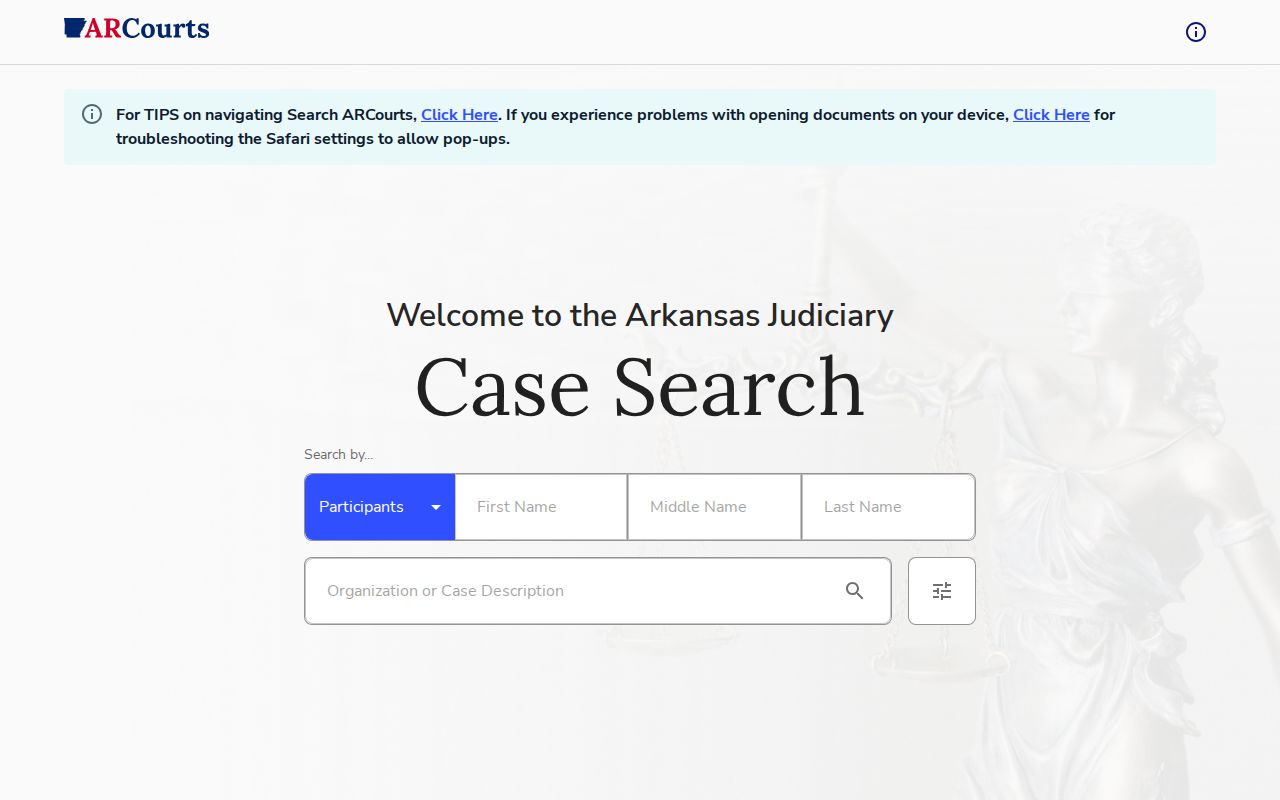
The search screen helps locate a case, while the clerk remains the official records custodian.
District Court County and City Cases
Calhoun County District Court has two important public contacts. County cases use Chief District Court Clerk Scilar Ray's county-case channel at P.O. Box 864, Hampton, 870-798-2165. City cases use Judge Tom Wynne's city-case listing at P.O. Box 783, Hampton, 870-798-2753. Lower-level criminal matters can live in either channel depending on the charge and filing source.
The Arkansas Judiciary profile for county cases is included in the manifest.
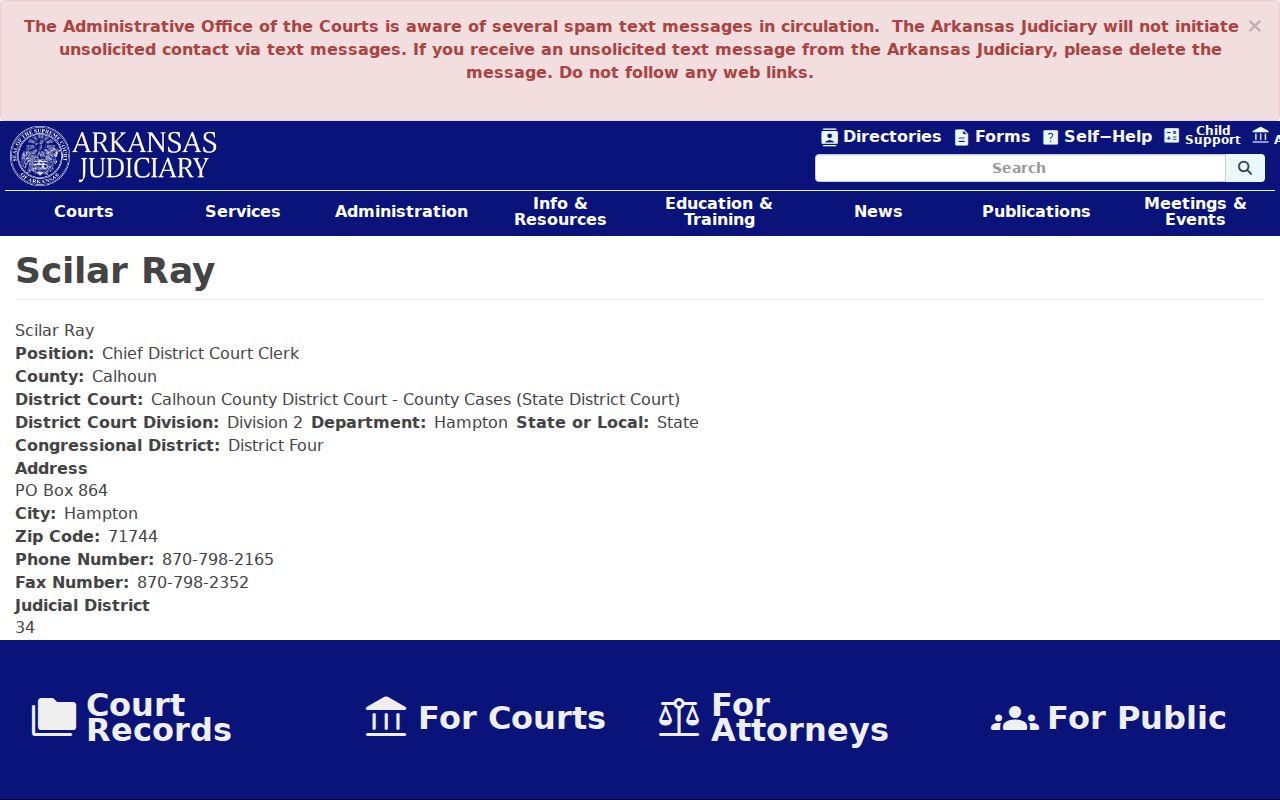
County-case and city-case contacts should not be merged when calling about a docket or payment issue.
A second district court manifest image covers the county-cases judge profile.
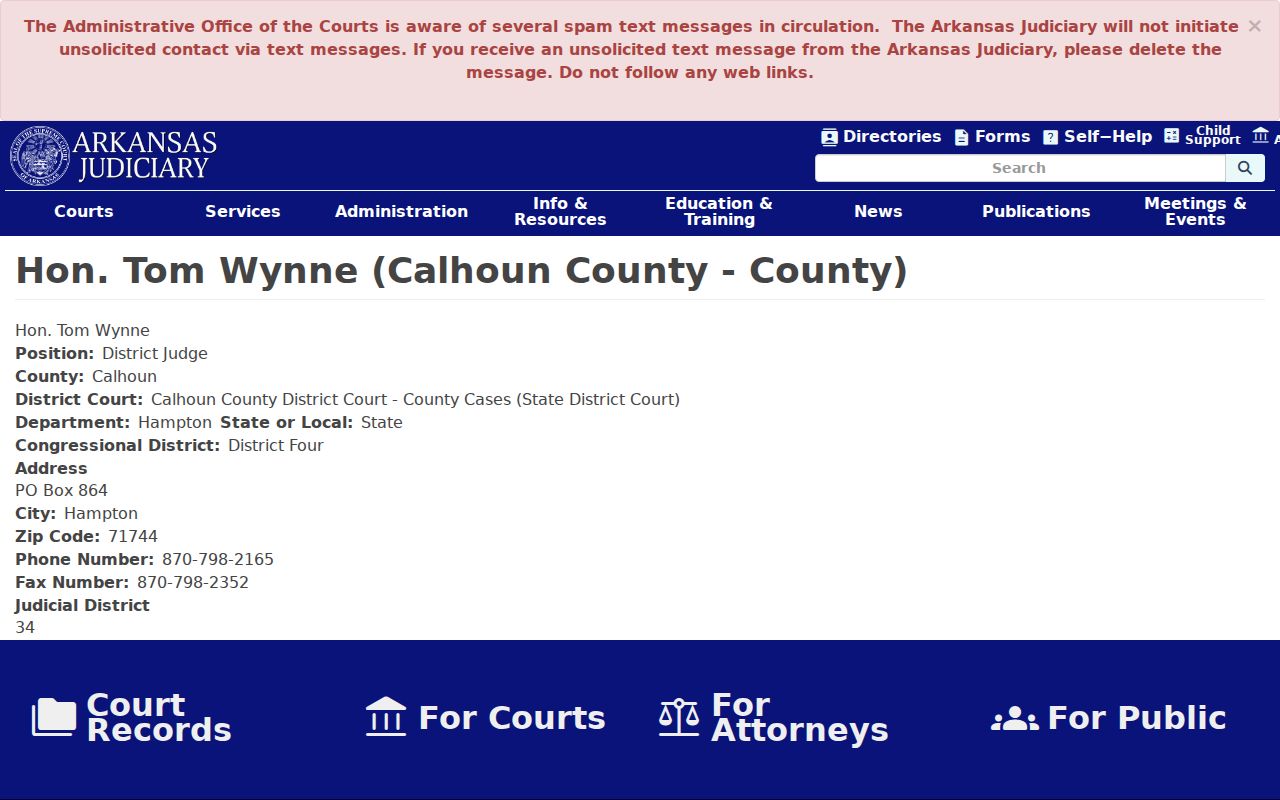
Those two listings explain why the same judge can appear in more than one local court channel.
The city-cases judge profile is also part of the criminal-case manifest image set.
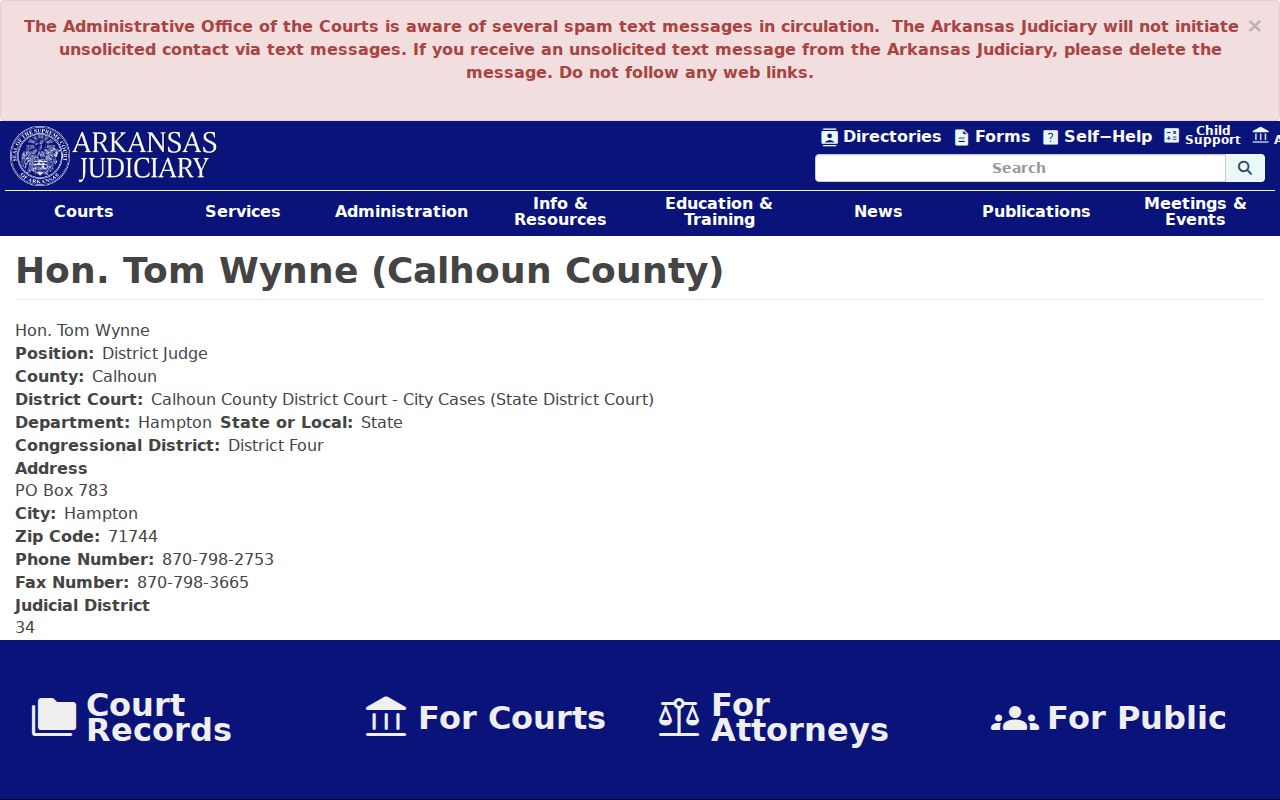
That separate city-case listing supports the page's warning not to call only the county-case number for every district matter.
Inside a Calhoun County Case File
A criminal case file is the court record, not the arrest report. It can show the charging document, parties, judge, docket entries, motions, pleas, dispositions, judgments, sentencing orders, costs, and future events. Online views can omit private identifiers, sealed entries, juvenile material, victim details, and restricted documents under Arkansas court-access rules.
| Case number and court | Identifies the filing court and lets the correct clerk locate the file. |
|---|---|
| Charging document | Shows the formal allegation or prosecutor-filed charge when public. |
| Docket entries | List hearings, filings, orders, and case movement over time. |
| Disposition | Shows whether a charge was dismissed, pleaded, convicted, acquitted, or otherwise resolved. |
| Sentence and conditions | May show jail, prison, probation, fines, costs, restitution, or suspended terms. |
| Restrictions | Sealed, juvenile, victim-protected, and confidential data may not appear online. |
Administrative Order 19 Limits Online Details
Arkansas Supreme Court Administrative Order 19 governs court-record access and explains why a public internet search can be narrower than the full public file at the clerk's office. Search ARCourts itself warns that some information is not public online. That does not mean every omitted field is secret; it means the internet display and the clerk's record-review process are different access levels.
When a Calhoun County case appears incomplete online, the next step is clerk contact, not a guess about the outcome.
How a Criminal Case Moves
Calhoun County criminal court cases begin after law enforcement or prosecutors move from an arrest or complaint into a filed court matter. A recent booking can appear before a court case is visible. A district matter can stay in district court, while a felony or circuit criminal case routes to Circuit Court.
Case flow: Arrest or complaint › booking when custody occurs › charges filed › arraignment › pretrial events › plea or trial › disposition › sentencing.
The regional prosecutor adds another layer. Calhoun County is served by the 13th Judicial District Prosecuting Attorney, so charging decisions may involve a regional office even while the court file remains local.
Reading Calhoun Disposition Terms
Disposition language is where many criminal case searches go wrong. A charge is an allegation. A disposition is the current or final outcome. A conviction is only one possible disposition. Dismissal, nolle prosequi, acquittal, plea, and sentence terms must be read in context with the docket date and count number.
- Disposition
- The current or final result of a charge or case count.
- Nolle prosequi
- A prosecutor's decision not to pursue a charge further.
- Arraignment
- A court appearance where charges are read and a plea is entered.
- Capias
- A court-issued arrest order, often tied to failure to appear or comply.
- Sealing
- Arkansas record-clearing process that limits public access after a signed order and processing.
Note: A jail charge can be amended, dismissed, or resolved differently after the court file develops.
Case Record Access and Restrictions
Most adult criminal court records are public unless a rule, statute, or order restricts them. Arkansas FOIA, Administrative Order 19, sealing law, juvenile restrictions, and victim-protection rules shape what can be seen online or copied at the clerk's office. Search ARCourts is useful, but it should not be treated as the whole court file.
For Calhoun County criminal court cases that do not appear online, call the correct clerk with the name, case number if known, approximate filing date, and court level. Ask about copy fees before mailing a request because no Calhoun-specific criminal case copy-fee schedule was found in the official sources used for the research.
Older, sealed, or restricted cases may need a clerk explanation. Repository products such as ARCH should be used only when the question is a state criminal-history product, not when the question is the full court file.